
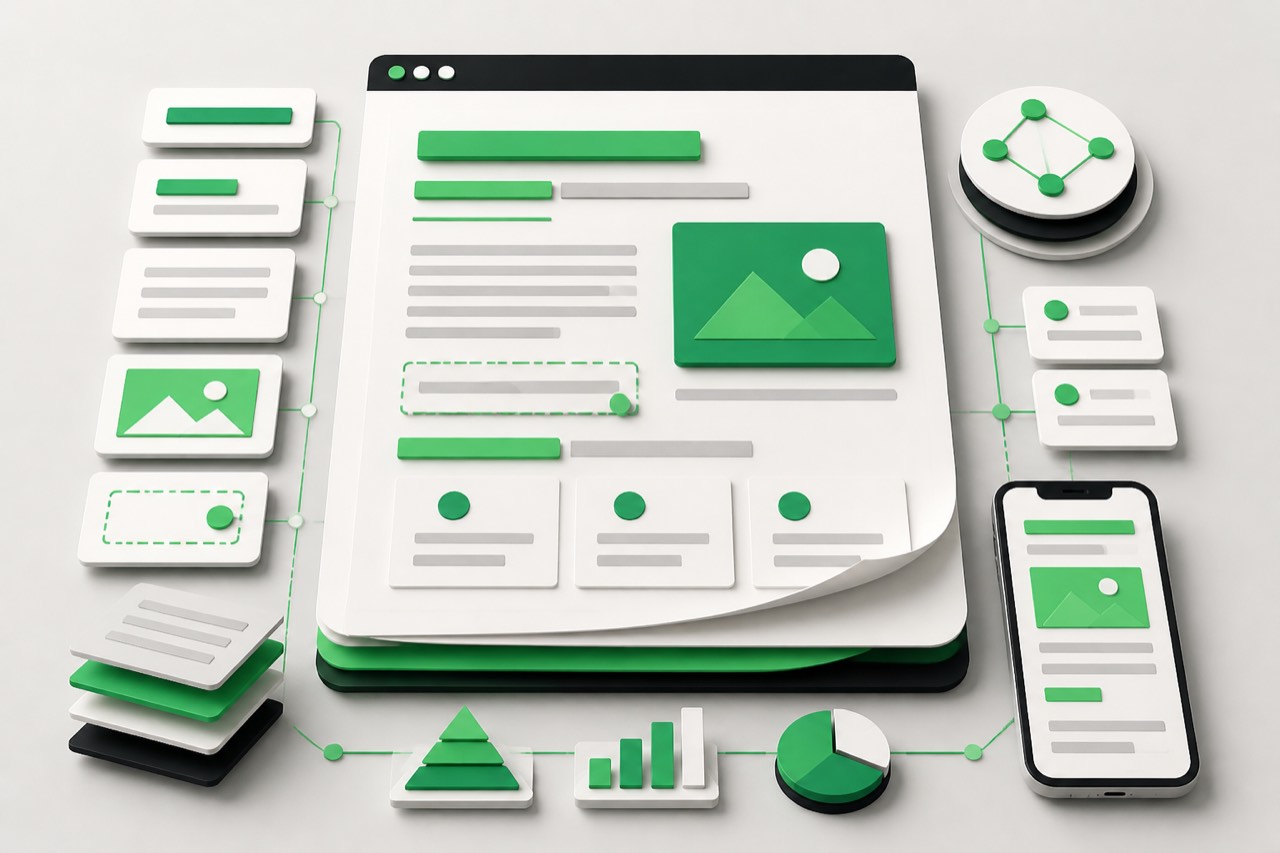
On-page SEO makes each page easier to understand
A useful page needs one clear job. A service page should explain a service and help a potential buyer decide. A guide should answer a question. A contact page should make contact easy. On-page SEO aligns the page’s topic, wording, structure and technical signals with that job.
Google’s Search Essentials recommends people-first content, prominent descriptive words, useful alternative text, descriptive link text and crawlable links. That is a better mental model than “put the keyword everywhere”. The aim is clarity, not repetition.
The main elements of on-page SEO
Search intent and page copy
Search intent is the task behind a query. Someone asking “what is on-page SEO” wants an explanation. Someone searching “on-page SEO services” is comparing providers. Giving both queries the same page creates a muddled experience. Write one strong page for each genuinely different intent.
Title tags and meta descriptions
The HTML title helps identify the page in search results and browser tabs. The meta description may be used as the result snippet. Both should describe the specific page honestly. They influence understanding and clicks, but a perfect title is not a ranking guarantee.
Headings and direct answers
One descriptive H1 establishes the subject. H2 and H3 headings break the explanation into logical questions. Put the conclusion near the start of each section, then add context. This helps busy readers scan and makes individual passages easier to retrieve accurately.
Image alternative text
Alternative text explains a useful image when it cannot be seen. It supports accessibility and gives search systems context. Describe what matters in the image. Decorative graphics should use empty alternative text, not a stuffed list of keywords.
Internal links
Internal links help visitors continue a useful journey and help crawlers discover relationships between pages. Use anchors that say what the destination contains. For example, this guide’s companion on on-page SEO versus backlinks explains the part that happens away from your website.
Structured data
Structured data is machine-readable information about a page, article, organisation or breadcrumb trail. It can clarify meaning and support eligibility for search features. Google explicitly says valid markup does not guarantee a rich result. Markup must match visible content.
Mobile experience, speed and crawlability
Google indexes the mobile version of a page. The same useful content and links should be available on small screens. Pages also need readable text, stable layouts, responsive images and reasonable loading times. Crawlability means search bots can reach the URL, follow ordinary HTML links and are not blocked by access rules or a noindex instruction.
A practical on-page SEO process, from intent to measurement
Optimising a page is easier when the work follows a clear order. Starting with keywords or schema before deciding what the page must accomplish often produces polished signals around weak information.
1. Choose one primary reader task
Write a one-sentence brief: “This page helps [audience] decide or understand [specific task].” Then examine the results currently returned for that query. A results page dominated by guides signals a different need from one dominated by service pages or tools. Do not copy competitors. Use the result types to understand the task Google believes searchers are trying to complete.
2. Build an information outline before writing
List the questions a reader must answer before leaving satisfied. For a service page these may include deliverables, suitability, process, cost factors, limitations and next steps. For a guide they may include a definition, examples, exceptions and an action plan. Turn those questions into descriptive headings and remove any section that exists only to repeat the target phrase.
3. Write the strongest answer first
Readers should not have to cross a long introduction to reach the answer. State the useful conclusion, then explain evidence, conditions and examples. This “answer first, depth second” structure works for human scanning and makes individual passages understandable when quoted outside the page.
4. Connect the page to a useful journey
Add internal links where the next question naturally appears. A person learning the basics may next need to compare on-page work with backlinks. A buyer assessing delivery may need the relevant service page or quote builder. Links should help the reader progress, not exist merely to distribute authority.
5. Verify the rendered page
Inspect the final URL, not only the document in an editor. Confirm the title, canonical, robots instruction, H1, visible copy, image text, links and structured data. Test at a narrow mobile width and check that important information has not disappeared. Google’s mobile-first indexing guidance says the mobile version should contain equivalent primary content and structured data.
6. Measure the right outcome
After publication, Search Console can show whether the page is indexed and which queries generate impressions and clicks. Business analytics should then show whether those visits take useful actions. A rising average position is encouraging, but enquiries, qualified leads and completed customer tasks matter more than a vanity keyword viewed in isolation.
Example: a Pune consultant may have one page titled “Services” covering strategy, training and speaking. The improvement is not to repeat “consultant Pune” twenty times. It is to decide whether those offers serve different search tasks, give each deserving task a focused URL, explain the buyer situation clearly and link the pages through a coherent service structure.
Important ranking factors also exist outside the website
On-page work can improve relevance, usability and technical clarity. Wider search performance can also depend on competition, reputation, useful mentions, quality backlinks, location, freshness where relevant and the search engine’s own systems. Headstart’s one-time on-page SEO service focuses on the part the website can control. It does not include link building or ranking guarantees.
On-page SEO is also not the same as technical SEO, although the two overlap. On-page work centres on the meaning and usefulness of individual pages. Technical SEO more often addresses site-wide access and delivery, such as redirects, duplicate URLs, XML sitemaps, server responses and large-scale rendering. A small business may need both, but calling every technical repair “content optimisation” makes scope and accountability unclear.
A business owner’s on-page SEO checklist
- Can you state the purpose of every important URL in one sentence?
- Does each page answer a distinct visitor question?
- Are the title, H1 and opening paragraph consistent with that purpose?
- Do headings tell the complete story when scanned alone?
- Are useful images described accurately?
- Do internal links use descriptive words and lead somewhere helpful?
- Is the complete content usable on mobile?
- Can search crawlers reach the canonical URL?
- Does structured data match what people can actually see?
Fix the largest clarity problem first
Do not begin by adding schema to a page whose copy says very little. Start with page purpose and useful information. Then improve the headings, links, metadata, images and technical delivery around it. Google’s SEO Starter Guide makes the same broader point: compelling, useful content is likely to influence a website more than many other checklist changes.
If the whole website needs clearer structure, you can build an itemised quote with the Get Found add-on. Treat the work as a prioritised improvement process, not a one-time insertion of keywords.